Looking to start or scale your portfolio in a blue‑chip suburb without taking on a massive building? Newton can work for small local buyers when you underwrite with care. Prices are high and yields are tight, but stable demand and strong rents create room for smart, steady plays. In this guide, you’ll learn how to pick the right 2–4 unit property, build a realistic pro forma, compare financing paths, and run due diligence the right way. Let’s dive in.
Why Newton attracts small investors
Newton sits at the high end of Greater Boston pricing, yet it also delivers strong renter demand. Zillow’s city pages show typical home values in the high six to low seven figures and citywide asking rents around $3,500 or more per month, which frames the basic cash flow math you need to solve. See the current city snapshot on Zillow’s Newton page for values and rent context.
- Reference: Check city value and rent context on Zillow’s Newton overview.
- Reference: The City of Newton’s FY2026 residential tax rate is $9.69 per $1,000 of assessed value.
- Reference: For small multifamily in Greater Boston suburbs, recent market commentary shows transactional cap rates commonly in the 4 to 7 percent range depending on location and risk.
- Reference: Regional rental vacancy in the Boston–Cambridge–Newton metro runs in the mid single digits. A conservative underwriting vacancy of about 3 to 6 percent is a reasonable starting point.
Links for the references above:
- Review Newton value and rent context on Zillow’s city page: Zillow Newton overview
- Verify the FY2026 residential tax rate: City of Newton tax rate
- Cap‑rate context for Greater Boston small multifamily: CREXI Boston market overview
- Metro vacancy background: ACS-based metro housing summary
What to buy in Newton
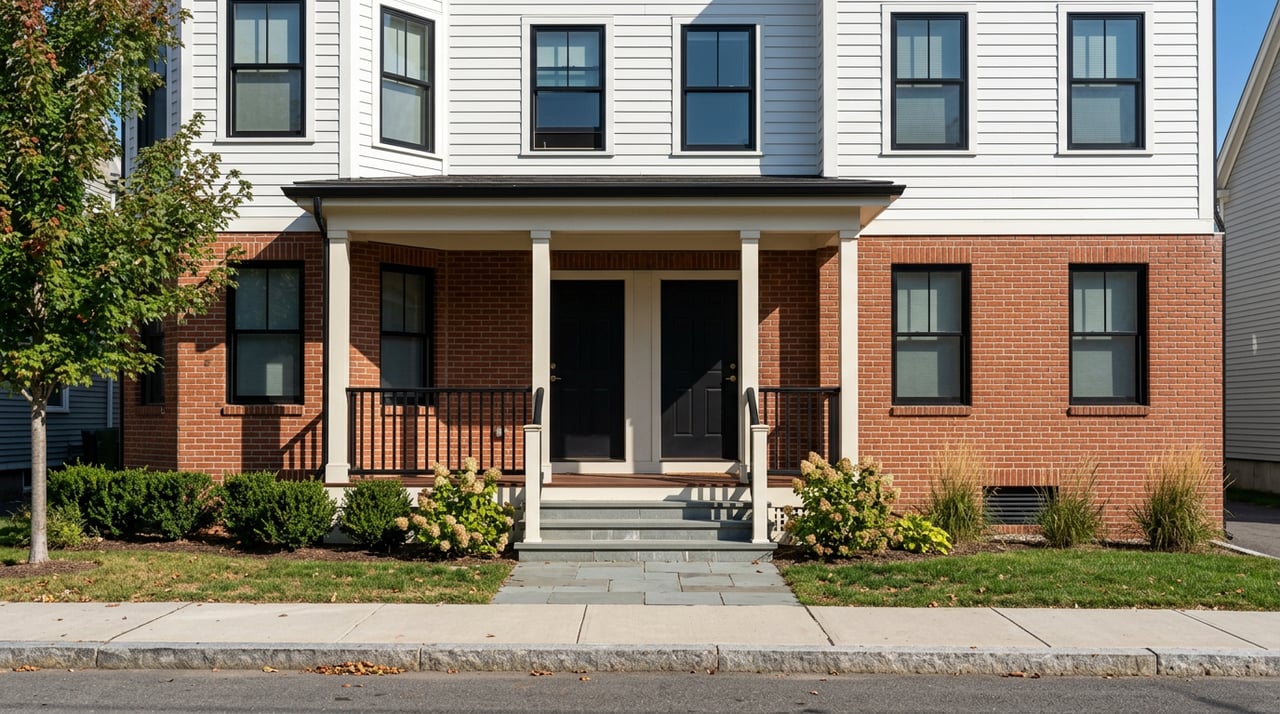
You will most often see 2 to 4 unit wood‑frame or masonry houses, small walk‑ups, and townhouse conversions near village centers and transit corridors. Many local buyers use an owner‑occupant approach, living in one unit and renting the others. Inventory and rent demand vary by village and zip, so build comps at the neighborhood level and confirm legal unit count early.
- Confirm legal use and learn what is permitted: Newton zoning and development
- Practical tip: Before assuming add‑a‑unit potential or parking relief, review the zoning ordinance and any adopted Village Center Overlay rules on the same page.
Build your pro forma
Market rents and other income
- Pull 3 to 5 rent comps in the same village or zip and adjust for beds, condition, parking, and amenities. Start with public indexes, then validate against current listings. Zillow’s Newton page is a quick source for city context and links to active listings.
- Consider other income streams: parking, laundry, storage, and pet fees. If you plan any short‑term rentals, Newton requires registration and limits STRs to primary residences with operating rules. Only count STR income if the plan meets the city’s requirements. See the city’s page: Newton short‑term rental information.
Vacancy and credit loss
- Use a conservative vacancy and collection loss in the 3 to 6 percent range unless your local comps support a tighter figure. Regional data shows low vacancy, but your village, unit type, and price point matter.
Operating expenses to budget
Include and estimate these categories:
- Real estate taxes. Use the City of Newton’s posted rate of $9.69 per $1,000 of assessed value and the actual assessed value from the assessor, not just the sale price: Tax rate reference.
- Insurance, owner‑paid utilities, routine repairs, capital reserves, property management and admin, legal and accounting, marketing and turnover, and any HOA fees.
- Rule of thumb: For older small multifamily in Northeastern markets, total operating‑expense ratios often land around 35 to 50 percent of effective income. Plan capital reserves around $200 to $400 per unit per year, adjusted for age and systems.
Key metrics to track
- Potential Gross Income (PGI): total scheduled rent plus other income, annualized.
- Effective Gross Income (EGI): PGI minus vacancy and collection loss plus other income.
- Net Operating Income (NOI): EGI minus operating expenses, excluding debt service and income taxes.
- Cap rate: NOI divided by purchase price.
- Gross Rent Multiplier (GRM): purchase price divided by gross scheduled rent.
- Cash‑on‑cash return: pre‑tax cash flow after debt service divided by your total cash invested.
Illustrative 3‑unit example (Newton) - verify current numbers
Assume you are evaluating a well‑located 3‑family.
- Purchase price: $1,650,000
- Unit mix: three 2‑bedroom apartments
- Market rents: $3,900 per unit per month
- Other income: $300 per month for two parking spaces and $100 per month for laundry/storage ($400 per month total)
- Vacancy and credit loss: 5 percent on scheduled rent
- Operating expense ratio: 45 percent of EGI (covers taxes, insurance, owner‑paid utilities, management, routine repairs, admin, and reserves)
Step 1: Income
- Scheduled rent: 3 units x $3,900 x 12 = $140,400
- Vacancy at 5 percent: $7,020
- Other income: $400 x 12 = $4,800
- EGI: $140,400 minus $7,020 plus $4,800 = $138,180
Step 2: Operating expenses and NOI
- Operating expenses at 45 percent of EGI: 0.45 x $138,180 = $62,181
- NOI: $138,180 minus $62,181 = $75,999
Step 3: Valuation signals
- Cap rate: $75,999 divided by $1,650,000 ≈ 4.6 percent
Tax planning note: Newton’s FY2026 residential tax rate is $9.69 per $1,000 of assessed value. If the assessed value is, for example, $1,450,000, the estimated annual tax would be about $14,051. Always pull the current assessed value and recent tax bill before finalizing your pro forma: Newton tax rate.
Sensitivity checks
- If market rents come in 5 percent lower, scheduled rent drops by $7,020. Recompute EGI and apply the same expense ratio to see how NOI and cap rate compress.
- If the property is reassessed 10 percent higher post‑sale, taxes will rise proportionally. Build a version of your budget with a 10 to 15 percent tax increase.
- If you assume a 6 percent vacancy instead of 5 percent, EGI falls by another 1 percent of scheduled rent. Check whether cash flow still supports your target return.
Use this framework to stress test your deal. Small changes in rents, vacancy, or taxes can move returns meaningfully in Newton’s price band.
Financing paths in Newton
Owner‑occupant options
If you plan to live in one unit, you can access programs designed for 2 to 4 unit homes.
- FHA and FHA 203(k) rehab loans allow you to buy and, if needed, finance renovations on 1 to 4 unit properties when you occupy one unit. Review program rules in HUD’s overview: HUD 203(k) consumer guide.
- MassHousing offers mortgage programs and down‑payment assistance for owner‑occupied 2 to 4 family purchases, subject to income and program guidelines. Start here and connect with an approved lender: MassHousing homebuyer programs.
Investor loans (non‑owner)
If you are not living in the property, expect larger down payments and income‑focused underwriting.
- Conventional investor loans as well as DSCR and other non‑QM products are common paths for 2 to 4 unit purchases. DSCR lenders underwrite the property’s ability to service debt. See a typical DSCR product description: Investor rental loans overview.
Loan limits and program fit
Conforming and FHA loan limits update annually and vary by county and unit count. Use official lookup tools to see whether your target property is conforming, high‑balance, FHA‑eligible, or requires jumbo financing: FHFA conforming loan limit map and the HUD program page linked above.
Newton due diligence checklist
Use this quick list to avoid surprises before you offer.
- Confirm legal unit count and permitted use. Review Newton’s zoning ordinance and any village‑center overlays: Zoning and development.
- Pull the assessor record and recent tax bills. Estimate taxes using the FY2026 rate of $9.69 per $1,000 of assessed value: Tax rate reference.
- Obtain the rent roll and compare to on‑market comps in the same village. Validate with multiple sources.
- Order a full inspection plus specialized checks for heating systems, electrical, plumbing, and a lead paint risk assessment for pre‑1978 buildings. Budget capital reserves accordingly.
- Check permit history and any open violations. Confirm required smoke/CO certifications prior to closing.
- Verify utility metering and who pays for heat, hot water, electricity, and water/sewer. Metering impacts both expenses and tenant billing.
- Get insurance quotes early. Premiums can be higher for older wood‑frame assets.
- Request 2 to 3 quotes from property managers for management and leasing fees. Their numbers will sharpen vacancy, turnover, and repair assumptions.
- Speak with an FHA/MassHousing‑savvy lender and a DSCR‑capable lender so you can compare owner‑occ and investor loan paths side by side.
Work with local pros who know Newton
Village‑by‑village nuance matters in Newton. A local team will help you source accurate rent comps, confirm legal unit history, estimate taxes off assessed value, and pick the right financing lane. If you want a second set of eyes on your underwriting or you’re ready to tour, connect with a boutique team that does small multifamily every week.
Ready to run the numbers on a 2 to 4 unit in Newton? Reach out to Zander Realty Group for neighborhood‑level comps, a clean pro forma, and introductions to lenders and property managers who work these assets every day.
FAQs
What cap rates should I expect on small Newton multifamily?
- Recent Greater Boston commentary shows small multifamily cap rates commonly around 4 to 7 percent, with location, condition, and risk driving where a given asset lands. See context here: CREXI Boston overview.
How do I estimate Newton property taxes for a 2–4 unit?
- Multiply the property’s assessed value by the FY2026 residential rate of $9.69 per $1,000; always use the assessor’s value, not just the sale price. Reference: City tax rate page.
What vacancy rate should I use in my pro forma for Newton?
- A conservative baseline of 3 to 6 percent fits the Boston–Cambridge–Newton metro’s low‑vacancy context; tighten or loosen based on village comps and unit type. Source: ACS-based metro housing summary.
Can I do short‑term rentals in a Newton multi‑family I occupy?
- Newton allows STRs only under specific rules, including registration and limitations tied to a primary residence; count STR income only if your plan meets the city’s requirements: Newton STR info.
What financing options exist if I live in one unit of a 3‑family?
- Owner‑occupants often explore FHA or FHA 203(k) rehab loans and MassHousing programs for 2 to 4 unit homes; review details at HUD 203(k) guide and MassHousing homebuyers.
How do I check whether my loan will be conforming, high‑balance, or jumbo in Newton?
- Use the FHFA loan limit map to see county and unit‑count limits, then compare to your price and loan size to determine program fit: FHFA loan limit map.