Trying to decide between a Somerville condo and a Cambridge condo? You are not alone. Both cities offer strong value, quick transit, and diverse building styles, but the right fit depends on your commute, budget, and long-term goals. In this guide, you will learn how prices and $/sq ft compare, where the amenities differ, how HOA fees impact your monthly cost, and a step-by-step way to compare listings apples to apples. Let’s dive in.
Market signals: price and $/sq ft
Cambridge and Somerville often overlap on price, but they move differently.
- Somerville’s citywide median sale price was about $899,375 in January 2026 (all home types). This signals a relatively high baseline for the market as a whole. (Source: Redfin, Jan 2026)
- A Warren Group and Banker & Tradesman review showed Somerville’s median condo price cooled slightly from about $900,000 in 2024 to roughly $875,000 in 2025. This highlights year-to-year variability that can open windows for buyers. See the discussion in Banker & Tradesman’s 2026 outlook.
- Cambridge tends to run higher on a per-square-foot basis, frequently in the $900 to $1,000+ per sq ft range in central neighborhoods near major employment and academic hubs. (Market snapshots from active listings support this range.)
What it means for you: medians hide the overlap. A new Somerville mid-rise near Union Square or Assembly Row can land in the same $/sq ft tier as mid-market Cambridge units. Older Cambridge condo conversions with fewer amenities can look closer to Somerville prices. Focus on per-foot value plus layout, amenities, parking, and building health rather than headline price alone.
What you get for the money
Somerville buildings and layouts
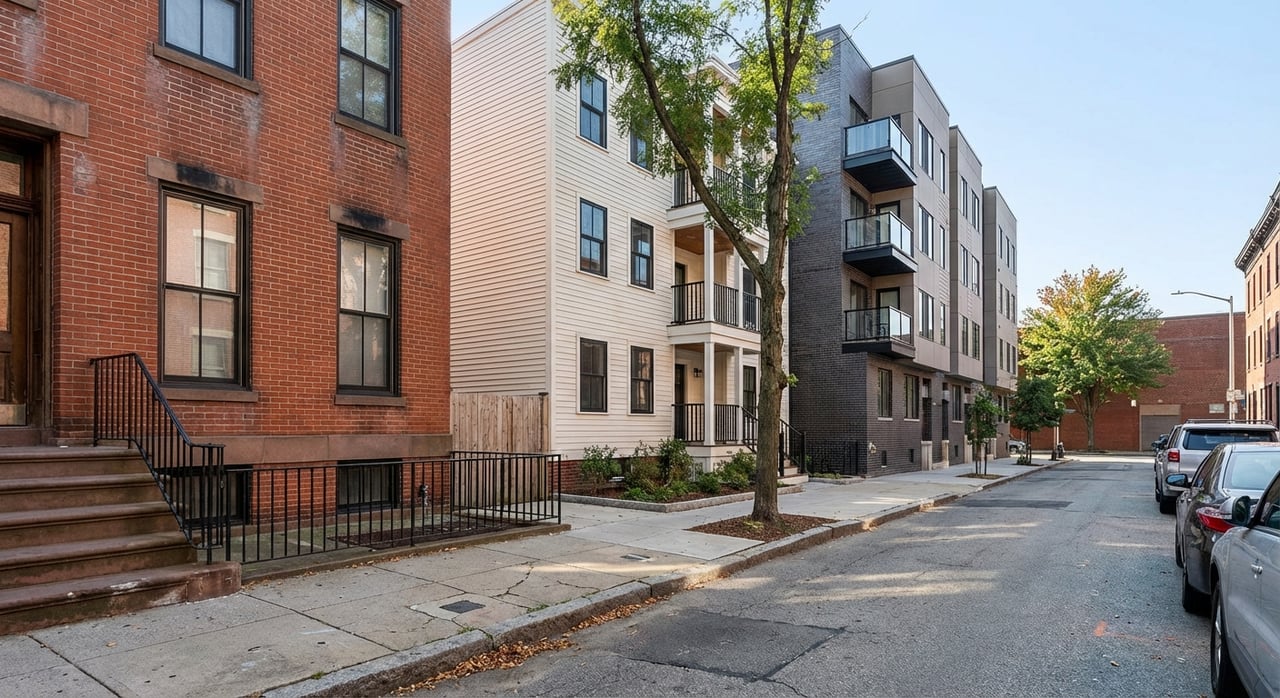
Somerville offers a large stock of classic triple-decker conversions and low-rise buildings, plus clusters of newer mid-rises around Assembly Row and Union Square. The city has moved to preserve and legalize triple-decker structures as part of its housing strategy, which helps maintain this common building type across neighborhoods. Learn more about the policy context from the City’s triple-decker update via MMA.
What to expect in units:
- Many 2–3 bedroom layouts in classic conversions with modest common amenities.
- Smaller associations with lower HOA dues but limited shared facilities.
- Newer mid-rises near transit and retail with elevators, in-unit laundry, and sometimes garage parking.
Cambridge buildings and layouts
Cambridge mixes historic brownstones and rowhouse conversions with mid-century garden condos and higher-amenity towers in East Cambridge, Kendall, and Cambridge Crossing. Newer buildings often emphasize lifestyle conveniences like concierge, fitness, garage parking, and storage. Planning and design documents for East Cambridge/Kendall illustrate these amenity-forward trends, such as those referenced in area development materials.
What to expect in units:
- Studios and 1-bedrooms common near schools and tech employers, plus upscale 2–3 bedroom options.
- Open layouts and in-unit laundry are typical in newer stock.
- Amenities can drive higher HOA fees, which impacts your monthly budget and resale positioning.
Transit and everyday value
Somerville’s recent transit upgrades expanded access and boosted nearby values.
- The Green Line Extension added new stations on the Union Square branch and the Medford/Tufts branch, while Assembly Row is served by the Orange Line. These changes improved rapid-transit access across Somerville and shifted demand within walking distance of new stops. See the City’s GLX overview.
Cambridge’s core Red Line stations remain a major draw.
- Kendall/MIT, Central, Harvard, and Porter deliver fast, frequent service into Boston and to Cambridge’s key employment centers. Davis Square, just over the line in Somerville, is also a high-use Red Line stop. You can review station context for Davis via MBTA references.
How to use this in your search:
- If you need daily Red Line access to Kendall or Harvard, you may value a Cambridge location enough to justify a higher $/sq ft.
- If you want newer buildings with retail and dining at your door, Somerville options near Union Square and Assembly Row can offer a strong tradeoff of price, space, and amenities.
HOA fees and condo documents to request
Your monthly HOA and the association’s financial health directly affect affordability and resale.
What to request from the seller or association before you commit:
- Current year operating budget and most recent financial statements
- Reserve study or reserve balance
- Meeting minutes for the last 12–24 months
- Master deed, bylaws, and house rules
- Any pending or approved special assessments
- Current insurance certificate
- Disclosure of any ongoing litigation
Why it matters: under Massachusetts condominium law, condo organizations have a lien for unpaid common expense assessments. That legal backbone means that unpaid fees, special assessments, or litigation can introduce direct risk to owners and to a unit’s liquidity. Review the statute at M.G.L. c. 183A, §6 and verify the unit’s account status with the association before you finalize an offer.
Fee ranges to expect:
- High-amenity Cambridge buildings often show HOA dues in the high hundreds to around $1,000+ per month, which typically cover some building services and sometimes utilities or heat.
- Smaller Somerville conversions can show notably lower monthly dues, but may also carry thinner reserves and higher special-assessment risk. Always read the minutes and reserve detail.
How to compare two listings side by side
Use this step-by-step method to keep your analysis consistent and objective.
- Define a precise search area
- Target a neighborhood, a few blocks, or a 0.25–0.5 mile walk to a specific station. Block-level variation can be large.
- Pull recent sold comps
- Focus on closed condo sales from the last 3–6 months. If volume is low, extend to 12 months. Record price, living area, beds, baths, floor, parking, and sale date.
- Compute $/sq ft and screen outliers
- Calculate the median and the interquartile range for your comp set. If a listing is 10–15 percent above the local median per-foot price, it needs a clear reason, like parking, a premium view, a penthouse position, or new finishes.
- Adjust for key unit attributes
- Positive adjustments: deeded garage parking, dedicated storage, elevator access, high ceilings, newer mechanicals, strong natural light.
- Negative adjustments: awkward layouts, low light, ground-floor privacy concerns, lack of in-unit laundry.
- Track your adjustments in dollars or percent so you can show how you reached an apples-to-apples number.
- Add the all-in monthly cost
- Include mortgage principal and interest, HOA dues, property taxes, and insurance. Note any utilities included in HOA, since that changes the comparison.
- Confirm lender friendliness
- Some loans require minimum owner-occupancy, reserve levels, or limits on single-developer control. If a building does not meet guidelines, your buyer pool shrinks at resale. Treat this as a red flag.
- Use days on market for leverage
- Longer days on market and repeated price cuts can signal motivation or overpricing. Have your agent pull the last 90–180 days of price history before you write.
Real-world examples to frame expectations
These examples illustrate how the two markets can overlap. Use them as a reference point while you review current listings and solds.
- Somerville mid-rise near Assembly Row: a 2025 sale around $900,000 showed per-foot pricing in the mid-900s. This demonstrates that newer Somerville buildings with transit and retail nearby can match Cambridge per-foot tiers.
- Cambridge amenity tower near East Cambridge/Kendall: active and recent units often show HOA fees around $800 to $1,100+ per month and price per foot around or above $1,000, reflecting concierge-style services, garage parking, and building amenities.
Takeaway: price per foot is only the start. Add layout quality, storage, parking, natural light, building reserves, and your actual commute to reveal true value.
Resale potential checklist
Score each listing 1–5 for the items below, then label the overall band as Low, Medium, or High.
- Transit proximity: walk minutes to Red, Green, or Orange Line stations.
- Investor concentration: high renter or investor share can limit certain loan options and slow resale.
- HOA health: reserve ratio, recent or pending special assessments, and any litigation.
- Building type and flexibility: triple-decker conversion, mid-rise, or modern amenity tower, and how that fits broad buyer demand.
- Parking and storage: deeded garage or surface parking and secure storage.
- Local employment access: proximity to Kendall Square, MIT, and nearby biotech and tech centers that drive demand.
Tip: keep the scoring sheet with your tour notes. When two homes feel similar, the checklist helps you pick the one with stronger resale odds.
Which city fits you best?
- Choose Cambridge if your top priority is Red Line access to Kendall or Harvard and you value in-building amenities like concierge, fitness, and garage parking. You will likely pay more per foot, but some buyers find the time savings and convenience worth it.
- Choose Somerville if you want newer mid-rises near restaurants, retail, and the Green or Orange Lines, and you prefer a larger floor plan or lower HOA dues for the same budget. Classic triple-decker conversions can deliver space and neighborhood character with modest monthly fees.
Your next step
If you are torn between two listings, run the side-by-side checklist above and get the condo documents early. A quick review of reserves, assessments, and days-on-market trends often reveals the better long-term choice. When you are ready for a data-backed tour plan, reach out to Zander Realty Group for local comps, HOA document review support, and a pricing strategy tailored to your goals.
FAQs
Are Somerville condos cheaper than Cambridge condos?
- On average, Cambridge runs higher on price per square foot, especially near Kendall, Harvard, and Central. That said, newer Somerville mid-rises near Assembly Row or Union Square can match Cambridge per-foot prices, while older Cambridge conversions can be closer to Somerville levels. Focus on $/sq ft plus unit quality and HOA health.
How do HOA fees compare between the two cities?
- Cambridge’s high-amenity towers often show HOA dues in the high hundreds to around $1,000+ per month. Somerville’s smaller conversions can have lower dues, but may also have thinner reserves. Always read the budget, minutes, and reserve detail before you commit.
Is Red Line access worth paying more for?
- If your daily commute targets Kendall/MIT, Central, Harvard, or Porter, immediate Red Line proximity can save time and reduce stress. Many buyers are willing to pay a premium for that convenience. If your routine centers on Assembly Row or Union Square, Somerville may offer a better price-to-amenity balance.
What condo documents should I review before buying in either city?
- Ask for the current budget, financials, reserve study or balance, minutes for the past 12–24 months, master deed/bylaws/rules, pending or approved assessments, the insurance certificate, and disclosure of any litigation. Verify your unit’s account status with the association.
How do I compare price per square foot fairly?
- Use recent sold comps from the same micro-area. Compute the median $/sq ft, then adjust for attributes like parking, storage, elevator access, natural light, and layout. If a listing is 10–15 percent above the median, ensure it offers tangible value to justify the premium.
How do transit changes in Somerville affect value?
- The Green Line Extension added new stations and improved access, which increased demand near those stops. If you can walk to a Green, Red, or Orange Line station within 5–10 minutes, that tends to support stronger resale over time. See the City’s GLX overview for context.