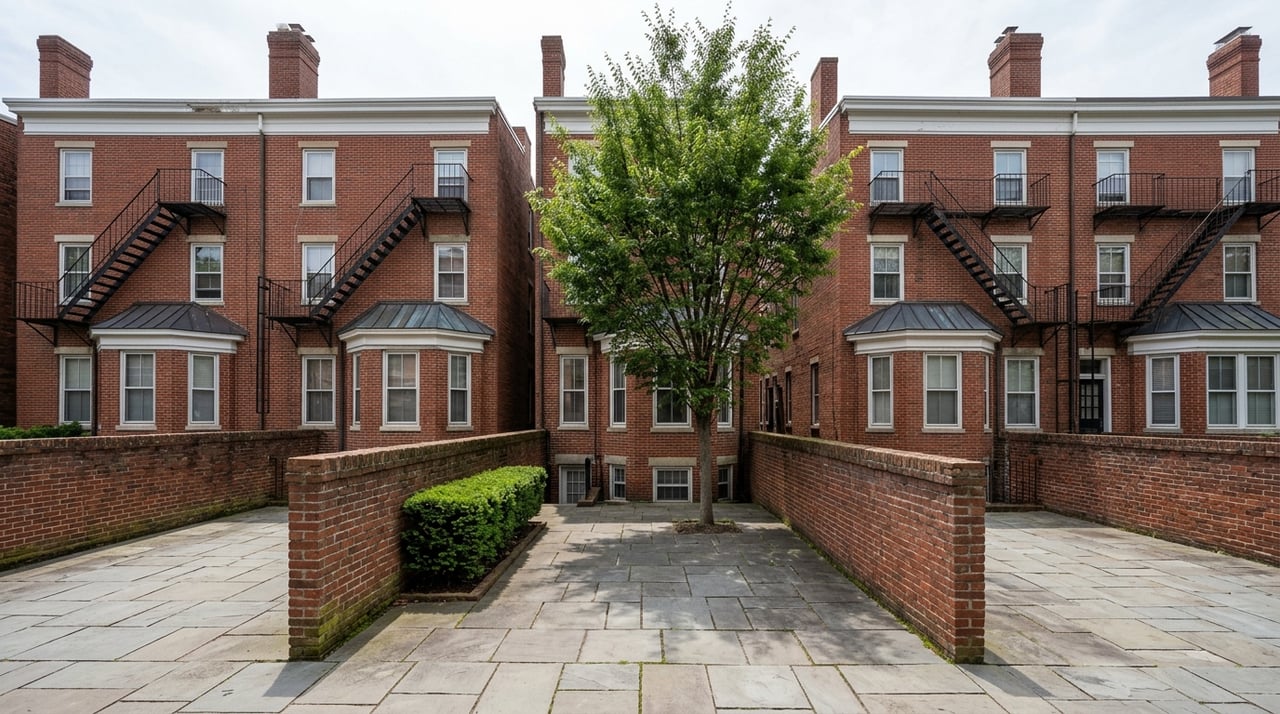
The lot at 26 Pleasant Street has held 60 or 62 parking spaces, depending on whose count you trust, for sixty years. It sits directly across from the Coolidge Corner branch of the Brookline Public Library, a short walk from the Green Line, and it has been owned by the same company, Nordblom, the entire time. In February 2026, Nordblom finally proposed doing something else with it: a seven-story building with 103 apartments. The company's senior vice president of development, Todd Fremont-Smith, told the Planning Board plainly that the site was "not the highest and best use for .6 acres of land in Coolidge Corner." He was right about the land. He was not close to right about the timeline.
If you're comparing Brookline to Newton or Somerville right now, you've probably read that the town rezoned itself in 2023 to allow thousands of new homes near transit, and you may be wondering whether that means more inventory, and softer prices, are coming. The honest answer sits in that parking lot, and in a second site two blocks away that's been zoned and waiting since before the pandemic. Neither is a building yet.
The Vote That Changed the Map, Not the Skyline
In November 2023, Brookline's Town Meeting passed a rezoning plan by a vote of 207 to 33, responding to the state's MBTA Communities Act, which requires transit-served cities and towns to allow multifamily housing as of right near stations. The town met its obligation mostly by rezoning the Harvard Street corridor, the commercial spine that runs through Brookline Village and Coolidge Corner, creating theoretical capacity for nearly 6,990 housing units. You can read the zoning bylaws and multifamily overlay maps directly on the town's site if you want to see which parcels were affected.
Theoretical capacity is the operative phrase. Zoning tells a developer what they're allowed to build. It says nothing about when, or whether, they'll build it.
Two Projects, One Corner, Two Very Different Clocks
26 Pleasant Street is the newer of Coolidge Corner's two marquee proposals, and it's already slower than its own first draft. Nordblom's plan went to Brookline's Spring 2026 Town Meeting in May, then the company asked to hold the article rather than push for a vote. By a July 15 community meeting, the project had shrunk from 103 apartments to 96, with 14 designated affordable instead of the original 15, and underground parking reduced to 48 spaces. It's now scheduled for the Fall 2026 Town Meeting, with a warrant deadline of noon on September 3, and Nordblom's attorney expects close to a dozen more public meetings before any vote, tentatively set for November. According to reporting from Brookline.News, the lot currently generates about $35,000 a year in property tax revenue. The finished building is projected to generate roughly $550,000. That gap is real money for the town, and it still hasn't closed a single unit.
Walk two blocks and you'll find the cautionary tale Nordblom's project is currently living through. Waldo-Durgin, a 61,000-square-foot site at Waldo, Pleasant, and John Streets, got its zoning approval from Town Meeting in 2019. Chestnut Hill Realty's plan calls for a 14-story, 143-unit apartment building alongside an 8- to 10-story, 200-room hotel. Two historic garages on the property were demolished roughly two years ago to clear the way. Construction still hasn't started. Chestnut Hill Realty's CEO, Ed Zuker, was blunt about where things stand:
"We've put probably $30 million into the property, we've had it cleared, we've done test wells for geothermal."
Zuker called the hotel design "pretty well designed" but said the apartment building is still in flux, citing interest rates and economic uncertainty. Seven years from zoning approval, and the site is still a fenced lot.
Here's the pipeline as of August 2026:
| Site | Zoning status | Units proposed | Current stage |
|---|---|---|---|
| 26 Pleasant Street | Amendment pending | 96 apartments, 14 affordable | Fall 2026 Town Meeting, vote expected November |
| Waldo-Durgin | Approved 2019 | 143 apartments plus 200-room hotel | Site cleared, no construction start date |
| 429 Harvard Street | Under review | Originally 40 units, revised smaller | Testing a scaled-down design |
| 1093 Beacon Street | Approved | 4 luxury condos (down from 18 planned apartments) | Converting shuttered office building |
Why a Finished Project Might Not Be the Relief You're Waiting For
Even where something does get built, the math doesn't automatically favor a buyer hunting for a deal. Look at 429 Harvard Street, a shuttered bank building where developer Oak Hill Properties proposed a six-story, 40-unit building in June 2024 using Chapter 40B, the state law that lets developers bypass some local permitting in towns short of affordable housing thresholds. At the town's request, the developer paused that plan to test whether a smaller four-story building under the new Harvard Street zoning could work instead. Smaller footprint, fewer units, still no shovels.
Then there's 1093 Beacon Street, in the Longwood neighborhood's National Registry Historic District. The original owners, Mark Blotner and Lloyd Rosenthal, bought the vacant office building in 2005 for $2.5 million and envisioned 18 apartments, mostly studios and one-bedrooms. After the property sold for $6.2 million in 2024 to developer Matt Ramey of Concept Properties, the plan flipped entirely: four floor-through luxury condos, each 1,800 to 2,600 square feet with four bedrooms, four bathrooms, and a private elevator. The Zoning Board of Appeals held its public hearing on the project December 18, 2025.
That's the pattern worth internalizing. When conversion economics in a high-transit corridor get tested, the math tends to favor fewer, larger, pricier units, not more affordable ones. A rezoned parcel eventually turning into housing doesn't mean it turns into housing a first-time buyer can compete for.
The Median Price That Contradicts Itself
While you're waiting on zoning to do something, you're probably also checking the price. And if you've looked at more than one source this year, you've noticed the town's median sale price doesn't agree with itself. For the three months ending June 2026, one widely used housing data feed put Brookline's median sale price at $1.3 million, down nearly 13 percent from the same period in 2025. A different brokerage's April 2026 market report placed the townwide median at $1,350,000, up more than 12 percent year over year. A third source pegged the March 2026 figure at $1,515,000, essentially flat. A fourth, blending single-family, condo, and multi-family sales together, listed the June 2026 median at $1,155,000.
Four sources, overlapping months, same town, four different stories. None of them are wrong. They're measuring different mixes of the same market.
Brookline isn't one housing market. It's two, running at wildly different price points, and whichever one closes more sales in a given month or quarter drags the blended median with it. Single-family homes in town have been trading with a median well north of $2.6 million in 2025, while condos have traded closer to $940,000 to $1.16 million depending on the stretch measured. Condos also move faster and see more transactions in a given period, so a month with a heavier condo mix can look like a price drop even when neither market actually got cheaper. A month with more single-family closings, especially in higher-end pockets, can look like a spike for the same reason.
Restrictive zoning, a stable population with low turnover, and proximity to the Longwood Medical Area keep single-family stock scarce and expensive, which pushes more buyers toward condos as the realistic entry point. That single dynamic, condos absorbing demand priced out of houses, is a big part of why the sales mix shifts from month to month and why the headline median swings with it.
What This Means If You're Comparing Brookline to Newton or Somerville
Stop reading Brookline's citywide median as a single number and start asking what closed. Coolidge Corner posted a $1,029,000 median in April 2026 across 13 sales, with price per square foot up more than 10 percent year over year even as sales volume slowed. Chestnut Hill, a very different product entirely, posted a $3,318,000 median across 5 sales the same month, with 80 percent of listings selling over asking. Those are two neighborhoods inside one town, both compressed into whatever blended figure you saw on a portal that day.
If you're weighing Brookline against a town like Newton, ask your agent for the property-type split, not the townwide average. And if part of your calculus is waiting for the MBTA Communities Act rezoning to loosen up inventory and soften prices, the timeline on Pleasant Street and Waldo-Durgin should adjust your expectations. Zoning approval in Brookline has, in recent years, meant a start on a years-long process, not a countdown to move-in day.
FAQ
Should I wait to buy in Brookline until the rezoning adds more supply? Based on the timelines at 26 Pleasant Street and Waldo-Durgin, that could mean waiting well beyond a typical home search. Waldo-Durgin's zoning was approved in 2019 and the site still isn't under construction.
Why do different sites report such different median prices for Brookline? Because Brookline's condo and single-family markets sit at very different price points, and any blended median shifts with the ratio of condo sales to single-family sales that closed in that window. It's a mix effect, not a value change.
Does the Harvard Street rezoning affect single-family home prices in neighborhoods like Fisher Hill or South Brookline? Not directly. The rezoning targets the commercial corridor for multifamily buildings. Brookline's single-family stock sits in separate zoning districts entirely.
If you're trying to make sense of what a specific Brookline listing, or a specific Coolidge Corner or Chestnut Hill comp, actually tells you about value, that's exactly the kind of read our team does every week. Zander Realty Group can pull the property-type breakdown for any Brookline block you're watching. Get an Estimate and we'll show you the numbers that actually apply to your search.