Trying to choose between a condo and a multi-family in Somerville? You are not alone. In a city where housing is tight, prices are high, and property types can feel very different from block to block, this decision can shape both your daily life and your long-term finances. If you are weighing simplicity against income potential, this guide will help you sort through the tradeoffs with local context in mind. Let’s dive in.
Why this choice matters in Somerville
Somerville is not a one-size-fits-all market. According to the U.S. Census Bureau, the city has an owner-occupied housing rate of 34.2%, a median owner-occupied home value of $911,300, median gross rent of $2,517, and median monthly owner costs with a mortgage of $3,452. That mix helps explain why many buyers here look closely at both lifestyle and carrying costs before choosing a property type.
The city’s 2025 Housing Needs Assessment also shows a very tight market, with vacant available rental and owner units both at just 1% to 2% in 2022. It also notes that two- to four-unit buildings remain a core part of Somerville’s housing stock, while condos and larger apartment buildings also play a major role. In other words, both options are common here, but they serve different goals.
Condo ownership in Somerville
A condo is usually the simpler ownership path. You buy your unit and a shared interest in the building’s common areas, which often means less direct responsibility for exterior upkeep and building-wide maintenance.
That convenience comes with structure. Under Massachusetts condominium law, condo associations can collect common-expense assessments, maintain financial records and reserves, and charge owners for shared costs. You cannot avoid those common expenses just because you do not use certain common areas.
For many buyers, that tradeoff is worth it. If you want a home that feels more predictable day to day, a condo can be a strong fit, especially if you prefer a more hands-off ownership experience.
Key condo advantages
- Lower day-to-day maintenance responsibility
- Often easier to manage if you have a busy schedule
- Active resale market in Somerville
- Good fit if you want to focus on homeownership more than property operations
Key condo tradeoffs
- Monthly condo fees add to your carrying costs
- Special assessments are possible
- You have less direct control over the full property
- Building decisions may depend on association rules and votes
Multi-family ownership in Somerville
A two-family or three-family property offers a very different experience. Instead of owning one unit within a building, you own the building itself, which gives you more control but also more responsibility.
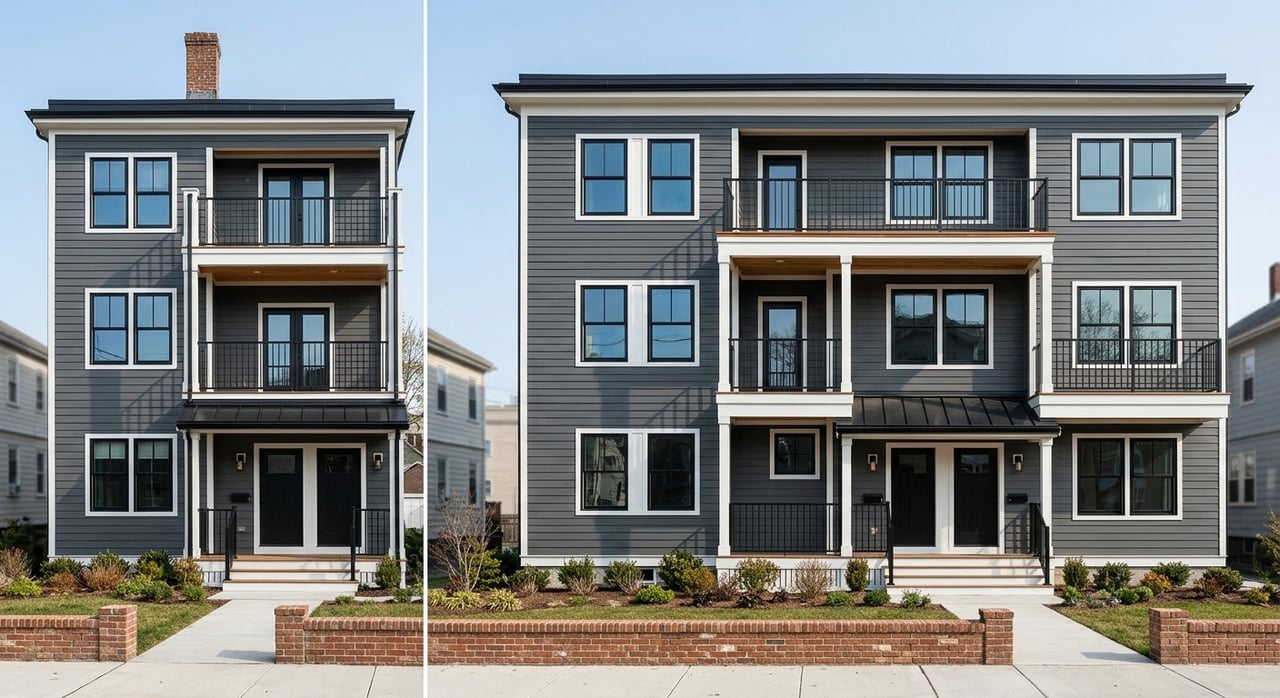
In Somerville, this matters because small multi-family buildings are a defining part of the local housing stock. The city’s housing assessment points to two- to four-unit properties as the primary housing type, and local planning documents describe triple-deckers as part of Somerville’s typical residential fabric.
If you plan to live in one unit and rent out the others, a multi-family can help offset your housing costs. In a city with tight vacancy and strong rents, that can be a meaningful part of your budget strategy.
Key multi-family advantages
- Rent from other units can help offset carrying costs
- More control over building decisions and maintenance timing
- Better fit if you want a home and an income-producing asset
- Potential access to local rehab support for eligible properties
Key multi-family tradeoffs
- More hands-on maintenance and management
- Repair costs fall more directly on you
- Carrying costs may be higher than many buyers expect
- Landlord-style responsibilities may not fit your lifestyle
Compare costs beyond the purchase price
In Somerville, the monthly cost picture matters just as much as the list price. You need to think about taxes, fees, maintenance, and any future repair plans.
Somerville’s FY2026 residential tax rate is $10.98 per $1,000 of value. The city also offers a residential exemption for owner-occupants that can save up to $4,578 in FY2026. That exemption can benefit a condo owner who lives in the unit or an owner-occupant of a small multi-family, but not a passive investor.
The city’s FY2026 mailer gives a useful snapshot of estimated tax-change impacts. It estimates average changes of $58 for a condo, $490 for a two-family, and $992 for a three-family, with those estimates including the residential exemption. That does not mean one property is always cheaper than another, but it does show how ownership costs can scale with property type.
Buyers should also account for the Community Preservation Act surcharge, which increased to 3% effective FY2026. That is part of the ongoing carrying-cost picture whether you buy a condo or a multi-family.
Think about this cost checklist
- Purchase price
- Monthly mortgage payment
- Property taxes
- Residential exemption eligibility
- Condo fees, if applicable
- Repair and maintenance reserves
- Community Preservation Act surcharge
- Possible special assessments or building-wide upgrades
Rental income changes the equation
If your goal is to reduce your own housing expense through rental income, a small multi-family is usually the more direct option. It is built for multiple households, and that aligns well with the way many buyers use these properties in Somerville.
The city’s 2025 Housing Needs Assessment says apartment buildings continue to appreciate citywide and rents remain strong, while vacancy stayed extremely tight in 2022. That supports the case for owner-occupants and buyers who value rental income potential.
A condo can still offer flexibility in some cases, but it is generally not the same kind of income tool. If your main goal is predictable ownership with less management, a condo may still win. If your main goal is offsetting costs through rent, the multi-family format usually makes more sense.
Short-term rental limits are stricter than many expect
Some buyers assume they can buy either property type and use short-term rentals to make the numbers work. In Somerville, that requires a closer look.
The city’s short-term rental ordinance requires the rental to be the operator’s primary residence. It also requires registration, prohibits renting separate bedrooms to different parties, and limits an unoccupied autonomous unit to 90 days per year. Shared units can be rented year-round only when the operator remains in the unit.
That means short-term rental income may be more limited than you first expect. If that strategy is central to your purchase decision, it is worth evaluating very carefully before you commit.
Renovation and value-add potential
Many Somerville buyers love older housing stock, especially classic two-families, three-families, and triple-deckers. These properties can offer character, space, and room for improvements, but they also tend to require a clear plan for repairs and upgrades.
The city’s Home Improvement Program may be relevant here. It can provide loans for eligible owner-occupied or investor-owned buildings with up to seven units, subject to program rules. For buyers looking at an older small multi-family, that can be an important local resource to explore.
Newer condos may appeal if you want newer systems and lower immediate maintenance needs. The city’s housing assessment notes that newer construction since 2019 has been concentrated in condos and larger apartment projects. It also shows that newer condos built since 2019 averaged 1,504 square feet and more than $916,000 in assessed value, while newer two-family homes averaged 3,538 square feet.
Exit strategy matters more than you think
Your best choice is not just about how you will live in the property now. It is also about how you may want to sell, hold, or reposition it later.
Condos appear to have a relatively active resale market in Somerville. The city’s housing assessment says condo sales have been running around 30 to 40 units per month, and the median condo sale price reached $850,000 in October 2024, up 33.1% from October 2019. If resale liquidity matters to you, that is an important factor.
With multi-family properties, some buyers think ahead to future condo conversion. In Somerville, that process is not simple. The Condominium Review Board must approve conversions, and the city tightened the ordinance effective October 1, 2025 by extending notice periods and increasing relocation assistance for formerly tenanted units. The city’s housing assessment also says condo conversions have slowed because of stronger tenant-rights rules.
If a future condo conversion is part of your long-term plan, it should not be treated as automatic. In Somerville, it is a strategy that requires careful review.
Which property type fits your goals?
The right answer usually comes down to how you want to live, what level of responsibility you can realistically handle, and whether you want your home to also function like an income-producing asset.
A condo may be right for you if
- You want simpler ownership
- You prefer less hands-on maintenance
- You value a more active resale market
- You want a home first, not a management-heavy property
A multi-family may be right for you if
- You want to live in one unit and rent the others
- You are comfortable managing maintenance and tenants
- You want more control over the building
- You see your purchase as both a home and a business-like asset
A smart way to decide
If you are stuck between the two, ask yourself one practical question: do you want easier ownership, or do you want more control and income potential? In Somerville, both paths can work, but they are designed for different kinds of buyers.
A condo is often the cleaner fit if you want a more straightforward homeownership experience. A two-family or three-family usually makes more sense if you are comfortable with a more hands-on role and want rent to play a part in your monthly budget.
The best decision is the one that matches your finances, your schedule, and your long-term plan. If you want help comparing specific Somerville condos and multi-family properties side by side, Zander Realty Group can help you break down the numbers and choose with confidence.
FAQs
Is buying a condo or multi-family more common in Somerville?
- Both are common, but Somerville’s 2025 Housing Needs Assessment says two- to four-unit buildings are the city’s primary housing type, while condos also have a large presence.
Are condo fees required for Somerville condos?
- Yes, condo ownership typically includes common-expense assessments through the condo association under Massachusetts condominium law.
Can a Somerville multi-family help offset my mortgage?
- It can, because living in one unit and renting the others is one of the main reasons buyers choose a two-family or three-family property in Somerville.
Does Somerville offer a residential tax exemption for owner-occupants?
- Yes, Somerville’s FY2026 residential exemption can save an owner-occupant up to $4,578, depending on eligibility.
Can I convert a Somerville multi-family into condos later?
- Possibly, but condo conversion in Somerville requires approval from the Condominium Review Board and follows local rules that became stricter effective October 1, 2025.
Are short-term rentals easy to run in Somerville?
- No, Somerville limits short-term rentals through primary-residence requirements, registration rules, and restrictions on unoccupied autonomous units.